Hundreds of strangers lined up to say goodbye to a young woman in the winter of 1933, and not one of them knew her name. All they had was a blue dress, 90 cents and a train ticket.
𝗖𝗵𝗿𝗶𝘀𝘁𝗺𝗮𝘀 𝘄𝗲𝗲𝗸, 𝟭𝟵𝟯𝟯. 𝗪𝗶𝗹𝗹𝗼𝘂𝗴𝗵𝗯𝘆, 𝗢𝗵𝗶𝗼.
Willoughby is a small city near the shore of Lake Erie, about 20 miles from Cleveland, and in the depths of the Great Depression money is tight in almost every house.
A young woman arrives in town and takes a room at a local boarding house. She stays a couple of days. She tells the landlady, Mary Judd, almost nothing about herself, not even a last name. By some accounts, she says only that she is called Kate.
Everything she wears is blue. Her dress, her coat, her scarf, her hat and even her little purse are all the same color.
𝗖𝗵𝗿𝗶𝘀𝘁𝗺𝗮𝘀 𝗘𝘃𝗲 𝗺𝗼𝗿𝗻𝗶𝗻𝗴.
She heads out toward the center of town, and about an hour later she comes back looking a little worried. She pays her bill and hands back her key.
At the door, she turns to the landlady and says: “Merry Christmas.”
Then she walks away with her suitcase.
Later that day, near the tracks on the edge of town, a New York Central passenger train strikes her. Accounts of those final seconds differ, and no one can say for certain what was in her mind.
She dies there, a stranger in a town that does not know her.
𝗧𝗵𝗲 𝗱𝗮𝘆𝘀 𝘁𝗵𝗮𝘁 𝗳𝗼𝗹𝗹𝗼𝘄.
Police search her things for a name. Her purse holds 90 cents, a handkerchief, a few small trinkets and a railway ticket to Corry, Pennsylvania. Her suitcase holds a towel, some pencils and some envelopes.
There are no letters, no papers and no address, and nobody calls the police station looking for a missing daughter.
The local funeral home takes her in. Then something nobody planned begins to happen.
Word spreads, and people start to come. By one local account, more than 3,000 people walk past to see the girl nobody knows.
Because of her clothes, the town gives her a name: the Girl in Blue.
𝗝𝗮𝗻𝘂𝗮𝗿𝘆 𝟱, 𝟭𝟵𝟯𝟰.
A resident donates a burial plot in the village cemetery. In the middle of the Depression, townspeople chip in for her stone, raising about $60. Another $15 goes into a fund so that flowers can be planted on her grave every year.
The cemetery caretaker, a man named Hank Heaverly, keeps collecting for her headstone long after others stop. When the money still falls short, he adds his own. Every year after that, he lays a wreath on her grave.
The plain stone reads: In memory of the Girl in Blue. Killed by train. December 24, 1933. Unknown but not forgotten.
𝟭𝟵𝟯𝟰 𝘁𝗼 𝟭𝟵𝟯𝟲.
Her story becomes news far beyond Ohio, and families with missing daughters study it with a mix of hope and dread.
At least two families come forward, sure that she is theirs. Both times, the missing woman turns up alive somewhere else.
In 1936, a man from Pennsylvania named Leo Klimczak looks at the photographs and says she might be his younger sister. Detectives even tell the Willoughby police chief her name. Yet the lead fades, and the stone stays unchanged.
𝗧𝗵𝗲 𝗱𝗲𝗰𝗮𝗱𝗲𝘀 𝘁𝗵𝗮𝘁 𝗳𝗼𝗹𝗹𝗼𝘄.
The Great Depression ends. A world war comes and goes. People who once stood in line at the funeral home grow old.
Still, people keep visiting the grave. They leave flowers, coins and little tokens for a woman they never met.
The Girl in Blue becomes part of Willoughby itself, a local legend passed from one generation to the next, while her flower fund keeps the grave bright every year.
𝗗𝗲𝗰𝗲𝗺𝗯𝗲𝗿 𝟭𝟵𝟵𝟯.
To mark 60 years since her death, the local paper, The News-Herald, runs her story again.
Far away, near Corry, Pennsylvania, the people at a small real estate office read it and stop.
They have been handling the sale of an old 100-acre family farm in Spring Creek, not far from Corry. In the paperwork is a sworn statement from 1985, signed by Leo Klimczak, the same brother who came forward in 1936.
It lists the heirs of his late father. Among them is a daughter, Josephine.
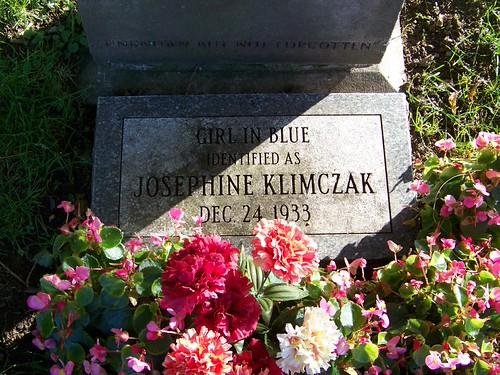
It says she died in an accident in Willoughby, Ohio, on December 24, 1933, and was buried there as the Girl in Blue.
Her name was Josephine Klimczak. Her family called her Sophie. Born in Spring Creek in 1912, she was only 20 or 21 years old.
The ticket in her purse had pointed back toward home the whole time.
Her family had known where she lay. Somehow, that knowledge never made its way onto her stone.
A local judge was asked to recognize her true name. Later, a local monument company donated a small second stone that finally says it. The old stone stayed exactly where it was. Her official death record still calls her the Girl in Blue.
We will never know why she was in Willoughby, or where she meant to go on Christmas Eve. Some answers stayed with her.
What we do know is what a town of strangers did with a story it could not solve. It gave her a funeral, a stone, flowers every year and 60 years of company.
Who in your own family’s story has been half-forgotten, and deserves to have their name said out loud again?
Her first stone could only call her unknown, but a town that never stopped bringing flowers made sure the second one could call her Sophie.