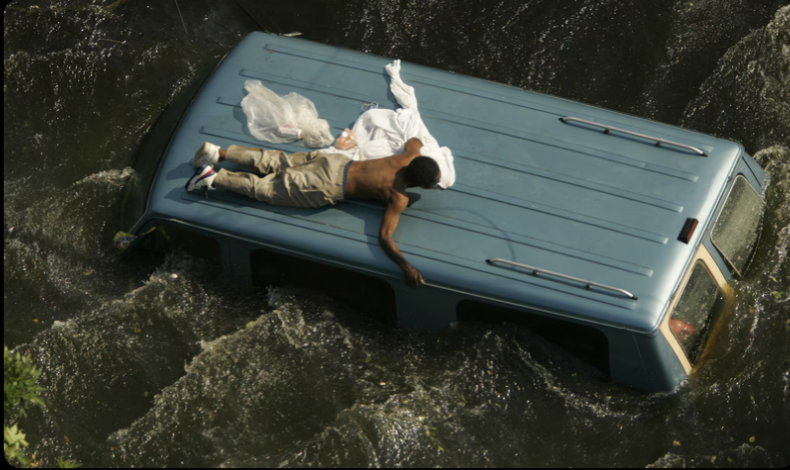
A man in khakis and mismatched tennis shoes clings to the roof of a van, six days after Hurricane Katrina. Brown floodwater covers the street on every side. Then a helicopter starts to circle, and one man on board is holding a camera.
𝗔𝘂𝗴𝘂𝘀𝘁 𝟮𝟵, 𝟮𝟬𝟬𝟱. 𝗦𝗼𝘂𝘁𝗵𝗲𝗮𝘀𝘁 𝗟𝗼𝘂𝗶𝘀𝗶𝗮𝗻𝗮.
Katrina comes ashore early on a Monday morning, about 45 miles southeast of New Orleans. For a few hours, many people believe the city has been spared, because the worst of the wind passes to the east.
But New Orleans sits in a bowl. On average it lies about 6 feet below sea level, kept dry by long walls of earth and concrete called levees. As the storm pushes water against them, they begin to break.
By August 31, about 80% of the city is under water. In some places it is 20 feet deep, enough to cover a one-story house, roof and all.
For the people still trapped inside the city, the way out now has to come by boat or from the air.
𝗟𝗮𝘁𝗲𝗿 𝘁𝗵𝗮𝘁 𝘀𝗮𝗺𝗲 𝗱𝗮𝘆.
The Coast Guard had planned for this. Before Katrina arrived, crews flew their helicopters out of its path, to Shreveport in Louisiana and Jacksonville in Florida, so the storm could not destroy them on the ground.
About 9 hours after landfall, the first Coast Guard rescue takes place. Within 12 hours, roughly 29 Coast Guard helicopters are working over New Orleans.
Rescue swimmers drop onto rooftops between power lines and floating wreckage. At the busiest point, about 80 of them are at work. They lift people out one at a time, in a harness or a metal basket.
𝗦𝗲𝗽𝘁𝗲𝗺𝗯𝗲𝗿 𝟭, 𝟮𝟬𝟬𝟱. 𝗡𝗲𝘄 𝗢𝗿𝗹𝗲𝗮𝗻𝘀.
Robert Galbraith, a photographer for the news agency Reuters, arrives 3 days after the storm. He flies in on a small Coast Guard plane with just 4 seats.
He has covered hard stories before. He later said Katrina went beyond anything he had covered in his career.
Within days, he is riding in a Coast Guard rescue helicopter, looking down through its open doors.
𝗦𝗲𝗽𝘁𝗲𝗺𝗯𝗲𝗿 𝟰, 𝟮𝟬𝟬𝟱. 𝗔𝗯𝗼𝘃𝗲 𝗡𝗲𝘄 𝗢𝗿𝗹𝗲𝗮𝗻𝘀.
Nearly a week has passed since the storm. Thousands of people are still waiting on roofs, porches and overpasses, and the crews cannot reach everyone at once. From the air, Galbraith could see almost nothing but ruin below.
Six days. In late summer heat, with water on every side.
Then the helicopter begins to circle, and it drops lower.
Below, on the roof of a van, is a man. He has no shirt on. He wears khakis and a pair of tennis shoes that do not match. It is a small detail, and it is the one Galbraith still remembered years later.
The van is almost gone under the water. All around it, the street has become a brown lake with nothing to hold on to.
Galbraith said the man was staring up at them, with “a look of terror on his face.”
He raises his camera and takes the picture.
The famous photo is not a rescue seen from far away. It is taken from inside the very helicopter that has come to save him.
𝗠𝗼𝗺𝗲𝗻𝘁𝘀 𝗹𝗮𝘁𝗲𝗿.
A Coast Guard rescue swimmer goes down to the van. He helps the man into a rescue basket. The cable winds in, and the basket rises toward the open door until hands reach out and pull him inside.
The helicopter turns and flies to Louis Armstrong Airport, the city’s main airport. There the man is laid on a stretcher and given medical care.
And here, his trail ends. The Reuters caption gives no name, and no reliable source we could find tells us what became of him after that day.
𝗦𝗲𝗽𝘁𝗲𝗺𝗯𝗲𝗿 𝟭𝟲, 𝟮𝟬𝟬𝟱. 𝗧𝗵𝗲 𝗳𝗶𝗻𝗮𝗹 𝗰𝗼𝘂𝗻𝘁.
The last Coast Guard boat rescues end. Of about 60,000 people who needed saving, the Coast Guard brought out more than 33,500. That includes 24,135 people lifted from danger and 9,409 patients carried to safety.
More than 5,600 Coast Guard members took part, and more than 45% of the service’s aircraft from across the country flew to the Gulf Coast. Officials reported that the air and boat rescues ran for about 17 days without a single accident or casualty.
𝗦𝗽𝗿𝗶𝗻𝗴 𝟮𝟬𝟬𝟲.
The President awards the Presidential Unit Citation to the whole United States Coast Guard for its work during Katrina.
We will probably never know the man’s name. We know his khakis, his odd shoes, the van and the date. That is all the camera kept.
But his photo stands for every one of those 33,500 people. Each of them had a moment like his, looking up at the sound of rotor blades and hoping it was coming for them.
And every one of those moments ended the same way, with a stranger reaching out a hand.
If you lived through Katrina, or helped someone who did, what do you remember most about those days?
Two odd shoes on a sinking van, and a basket coming down from the sky. Sometimes that is all hope looks like.