With each beat, her heart squeezes out just 13% of its blood. A healthy heart manages 55% or more. While doctors fight to keep her alive, her husband holds their newborn son and makes one quiet rule for every visitor.
Casey Gould had wanted to be a mother for as long as she could remember. Three miscarriages and years of failed fertility treatment had nearly convinced her it was never going to happen.
**January 2024.** Worn out, Casey and her husband, Ben Rosenberger, decide to stop trying. About a month later, she is pregnant.
The pregnancy is easy. There is some swelling near the end, but nobody is worried. Ben, a police officer in Hamilton Township, Ohio, starts picturing the three of them at home in Maineville. Casey has been picturing it for years: the first cry, the first cuddle, the moment a nurse lays her baby on her chest.
**November 1, 2024. Atrium Medical Center, Middletown, Ohio.**
Labour begins, and it goes on, and on. After roughly 36 hours, Casey is finally ready to push. Her readings look fine on every screen in the room, and an epidural has the pain under control.
But she can feel that something is wrong.
She later described dark shadows creeping into the corners of the room, first near her doctor, then near the nurses, while a heavy dread settled in her chest. She grabs her doctor with one hand and a nurse with the other.
She tells them: “Something’s wrong. I think I’m about to die.”
Seconds later, her baby’s heart rate drops.
Casey is rushed to an operating room and put under for an emergency C-section, and within minutes a healthy baby boy arrives. They name him Archer.
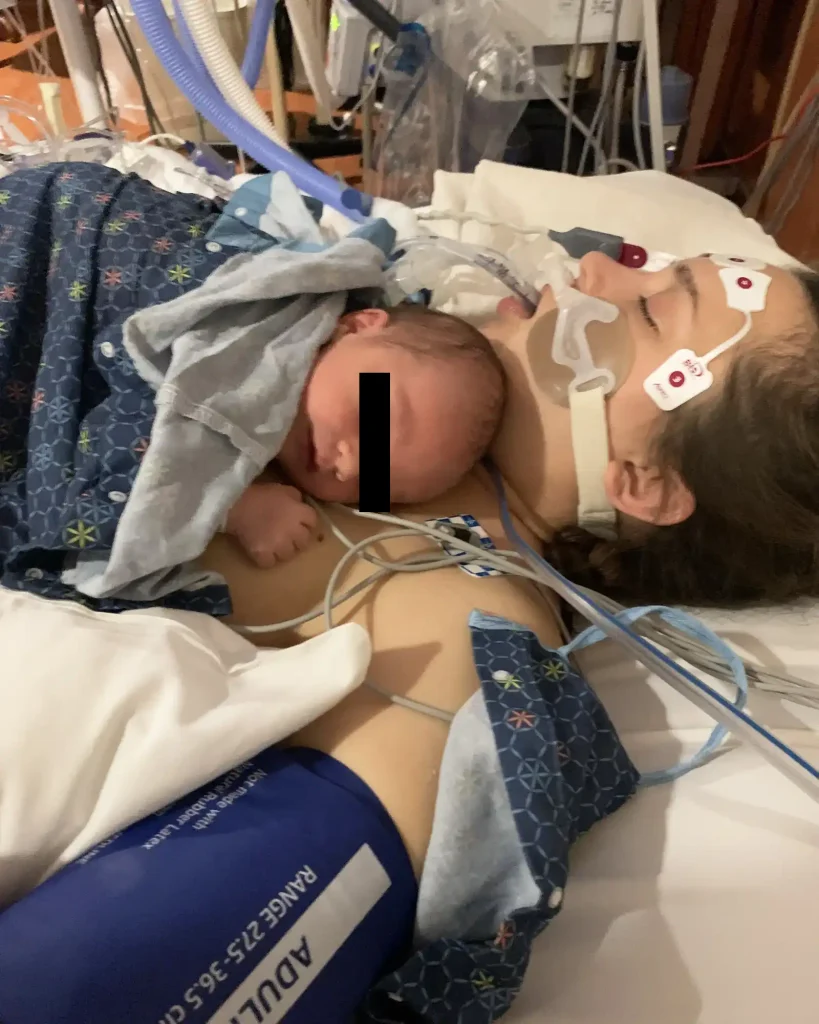
Ben gets ready to follow his son to the neonatal unit, because that is where babies go when a delivery turns frightening. Instead, someone places Archer in his arms. The baby is fine.
It is his wife who is in danger.
**November 2, 2024. The early hours.**
Casey’s heart is failing. The cardiologist, Dr. Amer Sayed, measures how much blood it pushes out with each beat, and the answer is 13%, against a normal range of 55 to 70%.
That is not a typo.
The diagnosis is peripartum cardiomyopathy, a rare form of heart failure that can strike around childbirth in women who seemed perfectly healthy days earlier. Dr. Sayed later put her chance of survival at about 50%. He has two options: the waiting list for a heart transplant, or a tiny pump called an Impella, threaded through an artery in her leg and into her heart so a machine can do the work while the muscle rests.
He chooses the pump.
At around 1 a.m., a nurse named Allison Specht takes a call about a 33-year-old woman in the cardiac lab. She assumes it must be an overdose. Then she hears the woman has just given birth. Only two days earlier, Allison had found out she was pregnant herself.
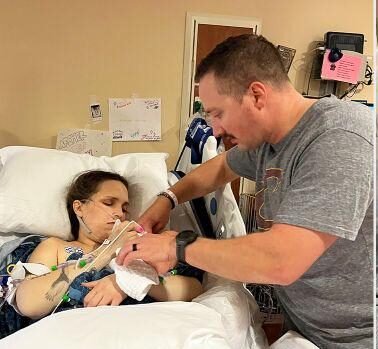
Casey is placed on a ventilator, in a medically induced coma. Ben can’t even go into her room.
So he sits with a newborn he never expected to care for alone, waiting to find out whether his wife will live. And somewhere in those long hours, a thought arrives that shapes everything he does next.
He later told PEOPLE: “I realized all these special moments she had fantasized over were stolen from her.”
He cannot fix her heart. He can protect what is left.
So he makes one rule. Nobody else holds Archer. Not the grandparents, not friends, nobody. The next arms to hold that baby will be Casey’s, whenever she wakes, if she wakes.
He wraps Archer in one of Casey’s sweatshirts for his first photos, so she is part of the pictures even when she can’t be in the room. And when doctors decide it is safe, he lays their son, skin to skin, on the chest of his unconscious wife, so that one day she will be able to see she was with him from the very beginning.
**Days later.**
Casey opens her eyes in intensive care, surrounded by machines, with no idea how much time has passed.
Her first thought is that Archer did not survive.
Within moments, Ben places their son in her arms. Apart from his father, nobody has held him. That moment was saved for her.
When she later learns what Ben did while she was unconscious, it changes how she sees her own marriage. She puts it in 7 words: “At my most vulnerable, he protected me.”
She spends 9 days in intensive care. Her heart slowly recovers, and her pumping strength climbs back into the normal range, though she will see a cardiologist for the rest of her life.
**November 2025.**
Casey, Ben and 1-year-old Archer walk back into Atrium Medical Center to meet the team that saved her. Dr. Sayed holds Archer while he talks, and the little boy spends the whole conversation playing with the doctor’s ID badge.
Casey is shown an Impella like the one that kept her alive. She calls it creepy that it was ever inside her.
Ben’s verdict is simple: “Everybody was in the right place at the right time.”
Allison, the nurse who took that 1 a.m. call, still talks to Casey almost every day.
Casey now shares her story so other women will trust that feeling of dread and say it out loud, the way she did.
But the part people remember is Ben. He had no power over the machines, the medicine or the odds. So he guarded the one thing he could, a first hold, and kept it safe for the person who had waited longest for it.
Has someone ever protected a moment for you when you couldn’t protect it yourself?