
Her trainer asks for a plank. Seconds later, it feels like a giant elastic band is tightening around her brain. She is 24, nine weeks from global fame, and the world will not hear what happens next for 8 years.
A year earlier, Emilia Clarke was fresh out of drama school. When she found out she had won the role of Daenerys Targaryen in a new HBO series called Game of Thrones, she celebrated the most ordinary way imaginable, with a packet of Oreos and an episode of Friends.
Now the first season is finished, the premiere is coming, and to cope with the nerves she has started working out with a trainer.
**February 11, 2011. Crouch End, North London.**
The headache starts in the locker room, before the session even begins. She is so tired she can barely get her trainers on, but she pushes through the first few exercises anyway, because that is what you do when you are 24 and your body has never let you down.
The plank turns the headache into something else entirely. She tells the trainer she needs a break, half crawls to the toilets, sinks to her knees and is violently sick.
Somewhere underneath the panic, she already knows her brain is in trouble.
An ambulance takes her to hospital. An MRI scan gives the answer fast. She has had a subarachnoid haemorrhage, a life-threatening type of stroke caused by bleeding into the space around the brain. An aneurysm, a weak bulge in an artery wall, has burst.
She later learned that roughly a third of people who suffer this kind of bleed die immediately or soon afterwards.
Someone hands her a consent form for brain surgery. Her first thought is that she is far too busy for brain surgery. Then she signs.
The operation lasts 3 hours. Surgeons reach the aneurysm through her blood vessels and seal it without opening her skull. When she wakes, the pain is unbearable, but she is alive.
**About two weeks later.**
A nurse wakes her in the night for a routine memory check and asks one simple question. What is your name?
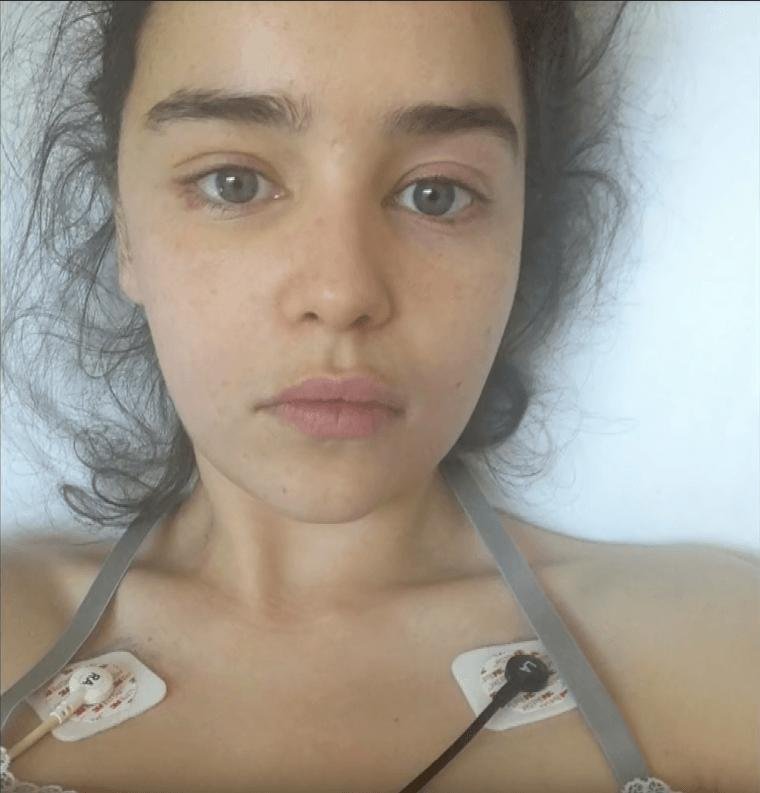
Her full name is Emilia Isobel Euphemia Rose Clarke. Five names, and she cannot find a single one of them. Only nonsense words come out of her mouth.
She has aphasia, a condition in which damage to the brain cuts the link between thought and language. She knows exactly who she is. The words just will not come.
For a young actress whose whole career depends on learning lines, this feels like the end of everything. In her darkest hours, she later admitted, she wanted to give up completely.
She is moved back into intensive care. About a week later, the words start returning, one by one, until she can say all five of her names again.
Read that again. She had to relearn her own name in the same spring the rest of the world was about to learn it.
Before she leaves, though, the doctors share something she will carry for the next 2 years. There is a second, smaller aneurysm on the other side of her brain. It might stay quiet forever. It might not. They will watch it with regular scans.
One month after she was rushed in, she walks out of hospital.
**April 17, 2011.**
Game of Thrones premieres and quickly becomes a worldwide sensation. Emilia goes on a publicity tour. Sitting in a London hotel room, so exhausted she can barely think, she sips morphine between interviews to keep the pain away. Not one journalist suspects a thing.
She is back on set for Season 2 within weeks. On camera, she never misses a beat.
**2013. New York.**
By now Emilia has finished 3 seasons and is starring on Broadway as Holly Golightly in Breakfast at Tiffany’s. A routine scan brings the news she has been dreading for two years. The second aneurysm has doubled in size.
Doctors expect this treatment to be simpler than the first.
When she wakes, she is screaming in pain. The procedure has failed and caused a massive bleed. Doctors tell her plainly that her chances of surviving are precarious unless they operate again, immediately.
This time there is no gentle route through the blood vessels. They have to go in through her skull.
She wakes with a drain coming out of her head. Pieces of her skull have been replaced with titanium, and a scar curves from her scalp down towards her ear.
She spends another month in hospital, and the fear is harder to fight than the pain. Anxiety and panic attacks arrive in waves. At times, she later wrote, she lost all hope.
Slowly, she goes back to work. She plays the Mother of Dragons for 5 more seasons, and outside a small circle of family and colleagues, almost nobody knows what that costs her.
**March 21, 2019.**
Weeks before the final season airs, Emilia tells the whole story in an essay for The New Yorker. On the same day, she and her mother, Jenny, launch a charity called SameYou.
It focuses on the part of a brain injury nobody films: the months and years after the hospital doors close behind you. Surgeons can save a life in a few hours. Rebuilding memory, confidence and a sense of who you are can take far longer, and in the UK, survivors are often lucky to get a few weeks of rehabilitation before the support simply stops.
**July 17, 2022.**
On BBC One, Emilia describes looking at scans of her own brain and laughs: “There’s quite a bit missing.”
**February 21, 2024.**
At Windsor Castle, Prince William presents Emilia and Jenny with MBEs for services to people with brain injuries.
**July 24, 2024.**
In Parliament, she speaks for survivors trying to return to work. A SameYou and Big Issue survey of 327 survivors found many went back before they were ready. She admits she once feared being fired from the show that made her. Her message to the room is simple: “Hospitals will fix your brain, but the recovery process will save you.”
Most of us met her as a queen walking out of fire.
The real courage was quieter than that. It was a 24-year-old learning her own name again, keeping a secret through 3 operations, and then choosing to spend her fame on the people still stuck in the hardest part.
Recovery does not end when the hospital discharge papers are signed. For many families, that is where the real work begins.
Have you, or someone you love, had to rebuild a life after the hospital visits stopped?