She won an Oscar at 16 for a role in which she speaks just one word. The woman she played had already held an Oscar of her own. And in 1961, the two of them finally came face to face.
**October 19, 1959. The Playhouse Theatre, New York.**
A 12-year-old girl from Queens walks onto a Broadway stage and barely speaks all night. She is playing Helen Keller at the age of 6, a child who cannot see, cannot hear, and has no words for anything in her world.
The girl is Patty Duke. She kicks, she grabs food from other people’s plates, she wrestles with Anne Bancroft, who plays Annie Sullivan, the young teacher hired to reach her. Their battle at the dinner table is so physical that when it was later filmed, both actresses wore padding under their costumes to avoid serious bruising.
Audiences are stunned. The play runs for 719 performances and wins the Tony Award for Best Play. Duke stays with it for 19 months, until May 1961, and her name is raised above the title on the theatre billboard, believed to be the first time that was done for such a young star.
What the crowds never see is the life she goes home to each night.
Her managers, John and Ethel Ross, control almost every part of her childhood. Years earlier, they even took away her name. She later wrote that they told her: “Anna Marie is dead. You’re Patty now.”
So every evening, a girl who has been told exactly who to be walks on stage as a girl who has no way to tell anyone who she is.
**1961.**
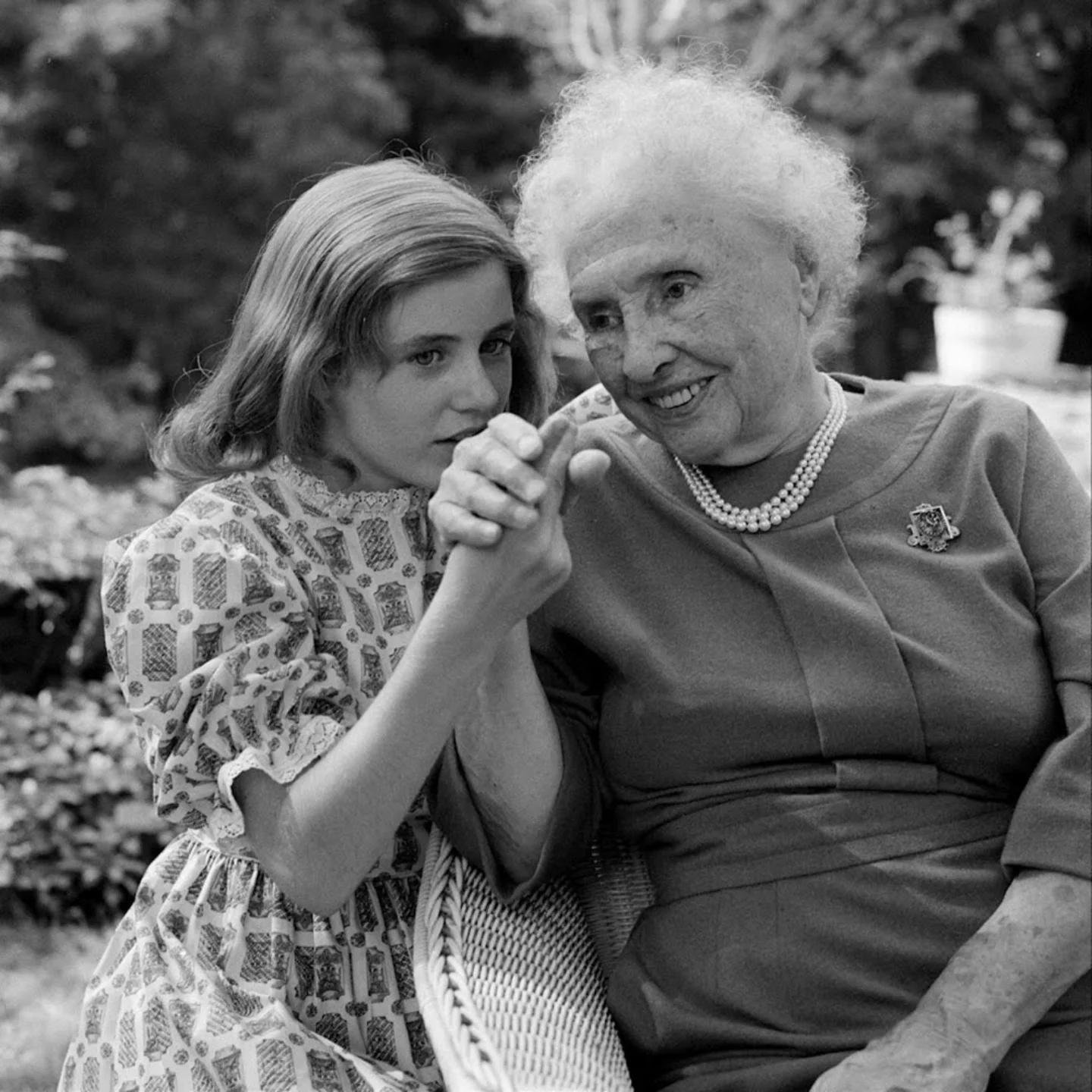
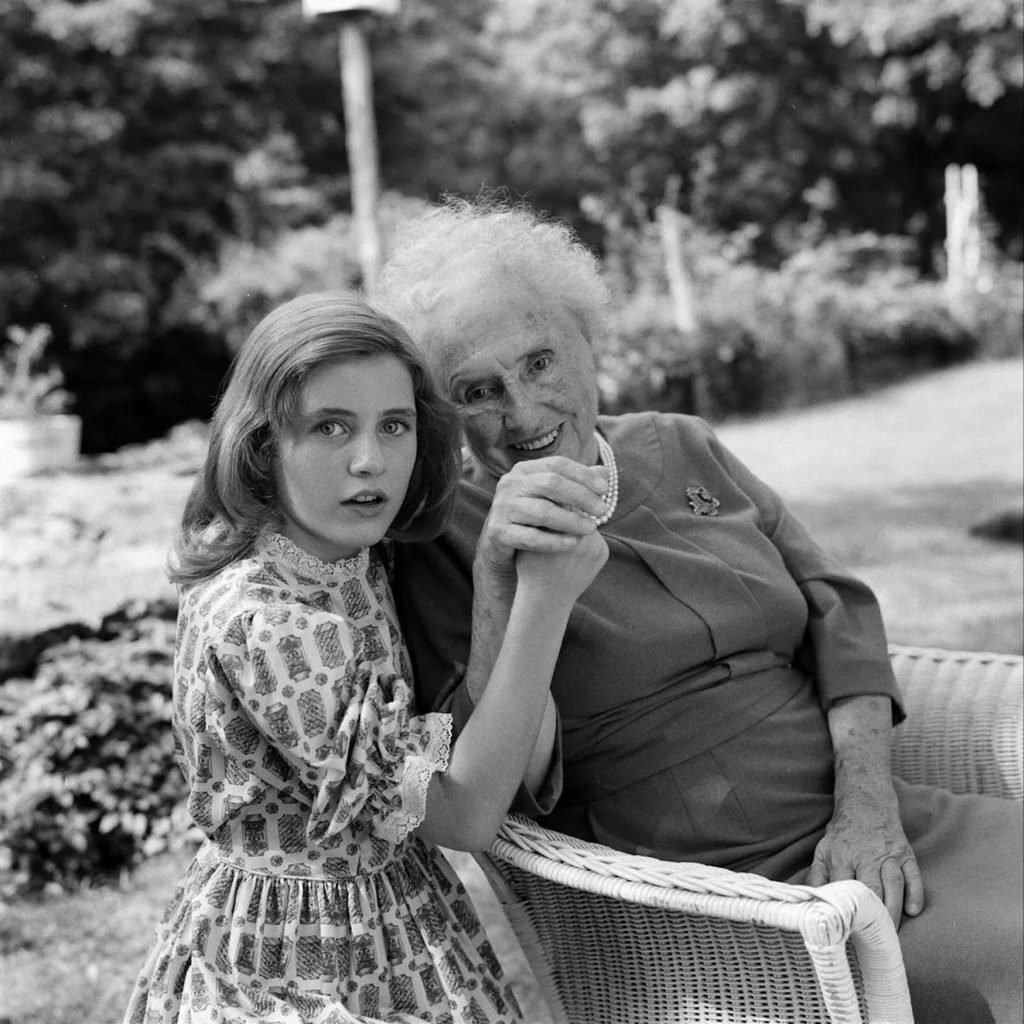
Her Broadway run is over and a film version is on the way. Before the cameras roll, Patty Duke meets the real Helen Keller.
Keller is 81 years old. She lost her sight and hearing after an illness at just 19 months. She graduated from Radcliffe College in 1904, the first deafblind person to earn a Bachelor of Arts degree, and she has spent decades travelling the world to fight for people with disabilities.
LIFE photographer Nina Leen captures the meeting. In one frame, Keller sits with her pet dog curled in her lap. In another, the 14-year-old actress who has shouted, crawled and fought as Helen hundreds of times gazes up into the face of the woman herself.
Duke later said no role and no award ever compared with that day. She called it a religious experience.
There is something else most people never connect. In March 1956, a documentary called Helen Keller in Her Story had won the Academy Award for Best Documentary Feature, and Keller herself was photographed holding the golden statuette.
**October 1961.**
Only months after that meeting, Helen Keller suffers her first stroke. She retires from public life and spends her remaining years quietly at Arcan Ridge, her home in Connecticut.
The woman whose childhood is about to reach cinemas around the world will never again step back into the spotlight.
**May 1962.**
The Miracle Worker opens in cinemas. Duke plays Helen again opposite Bancroft. In the entire film, Helen speaks a single word. It comes at the water pump, recreating the real moment on April 5, 1887, when Annie Sullivan spelled W-A-T-E-R into young Helen’s hand and the world suddenly had names.
An Oscar-winning performance built on one spoken word. That is not a typo.
**April 8, 1963. The Academy Awards.**
George Chakiris opens the envelope for Best Supporting Actress and reads out Patty Duke’s name. She is 16, the youngest person at that time ever to win a competitive Oscar.
She told the Los Angeles Times: “When they announced it, I just sat there. I couldn’t move.”
Her acceptance speech is two words long: “Thank you.” The same night, Anne Bancroft wins Best Actress.
So the same life story has now produced two Oscars, 7 years apart. One for Helen Keller playing herself. One for a teenager playing the child she used to be.
**1979.**
Duke returns to The Miracle Worker, but this time she is the teacher. She plays Annie Sullivan, with Melissa Gilbert as Helen, and wins an Emmy for it.
Keller was gone by then. She had died on June 1, 1968, at 87, four years after President Lyndon B. Johnson awarded her the Presidential Medal of Freedom.
But Duke never let go of her. The American Foundation for the Blind gave her its Helen Keller Achievement Award in 2001. She recorded the accessible edition of a book of Keller’s quotations, and said that not a single day passed without her thinking of Helen Keller.
**May 2011.**
Duke directs The Miracle Worker for the very first time, at a small theatre in Spokane, Washington.
She admitted that for much of her life she had struggled to sleep. Her cure was always the same. She would lie in the dark, start at the very beginning of The Miracle Worker, and say every line of the play, all the way through to the end.
The play that made her famous had also become the thing that calmed her.
Patty Duke died on March 29, 2016, at 69. She worked for more than half a century and won Emmys, but the role she carried to the end was a little girl at a water pump, and the remarkable woman she was lucky enough to meet.
Some people shape a whole life just by being who they are. For Patty Duke, that person was Helen Keller. Has someone ever changed the way you see the world after just one meeting?
Helen Keller spent her life proving that silence and darkness do not have to be the end of the story. A frightened child actress, renamed and controlled by others, found in her a standard to live up to.