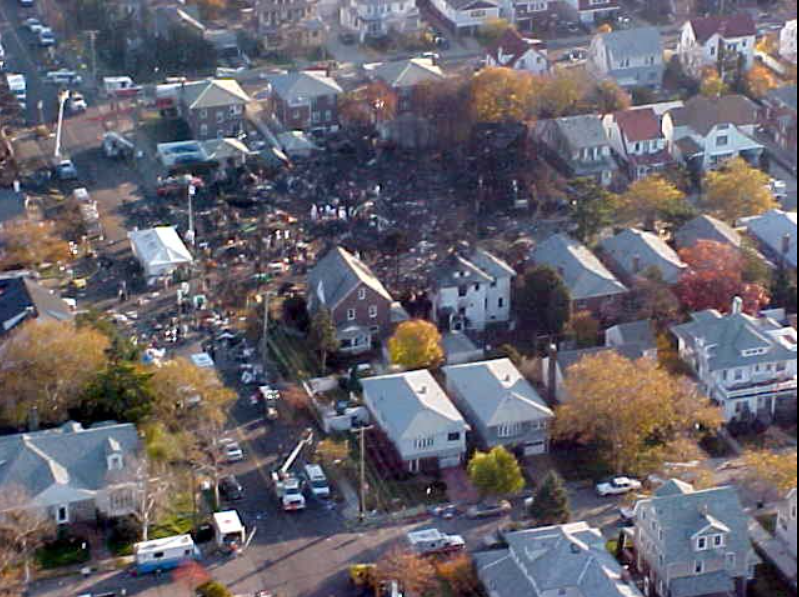
Two months after 9/11, a passenger jet falls out of the sky over Queens, New York, and 265 people die. A frightened city braces for another terror attack. The truth, when it finally comes, begins with a pedal that moves little more than an inch.
**Monday, November 12, 2001. JFK Airport, New York.**
American Airlines Flight 587 is lined up for takeoff, bound for Santo Domingo in the Dominican Republic. The plane is a wide-body Airbus A300 carrying 251 passengers, 7 flight attendants and 2 pilots.
Many of the passengers are Dominican New Yorkers on their way home to see family.
In the cockpit sit Captain Ed States, 42, and First Officer Sten Molin, 34. At 9:13 a.m., the captain hands over the controls with four ordinary words: “You have the airplane.” Molin will fly this leg.
A minute and 40 seconds before Flight 587 leaves the ground, a Japan Airlines Boeing 747 lifts off from the same runway. The controller spaces the two jets exactly as the rules require. Nothing about this morning is unusual.
**Liftoff.** The Airbus climbs out over Jamaica Bay.
A jumbo jet leaves something invisible behind it. Its wingtips twist the air into spinning tunnels called wake vortices, a little like the churning water behind a speedboat, and a smaller plane that crosses them gets rocked.
**9:15:36.** Flight 587 brushes through the 747’s wake for the first time. The plane wobbles and settles. It is the kind of bump experienced pilots feel and forget.
**9:15:51.** The second encounter is stronger.
What happens over the next 7 seconds will take investigators almost 3 years to explain.
The first officer pushes hard on the rudder pedals, one side and then the other, again and again. Every swing makes the plane slide sideways through the air, and every slide piles more force onto the tall fin at the back of the aircraft, the vertical stabilizer.
**9:15:58.** The fin breaks away.
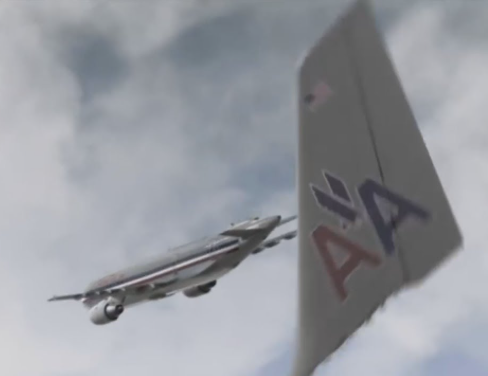
The entire tail, rudder and all, tears off and drops into Jamaica Bay. Without it, the A300 cannot hold a straight line. It yaws violently, and the forces rip both engines from the wings. They land several blocks from the main wreckage.
At 9:16 a.m., Flight 587 comes down on a quiet residential street in Belle Harbor, Queens. Everyone on board is killed, and so are 5 people on the ground.
From liftoff to impact, the whole flight lasts about 106 seconds.
Remember where this is happening. It is 62 days after September 11, and Belle Harbor, a seaside neighbourhood of firefighters and Wall Street workers, has already lost residents in the Twin Towers. Smoke rises over New York again, the city’s airports shut down, and nearly everyone assumes the worst.
The recorders tell a different story. There is no bomb and no sabotage. When the tail is lifted out of the bay, testing shows it was built exactly to specification. It had not been weak. It had been asked to carry loads far beyond anything it was designed to survive.
Then investigators find something harder to accept. According to their analysis, if the rudder had simply been left alone, the plane would most likely have steadied itself.
**October 26, 2004.** The National Transportation Safety Board adopts its final report. The tail failed, it concludes, because of the first officer’s “unnecessary and excessive” rudder pedal inputs.
But the board does not stop at one man. It names two reasons a trained, experienced pilot might fly that way.
The first is in the cockpit. On the A300-600 at higher speeds, a pilot could get full rudder from roughly 1.25 inches of pedal movement and about 10 pounds of extra pressure. An American Airlines official later testified that before the crash, he did not believe any pilot would have known that.
Read that again. Barely more than an inch under a pilot’s shoe.
The second is in the classroom. Years earlier, Molin had gone through the airline’s Advanced Aircraft Maneuvering Program, which taught that rudder could help pilots control roll during upsets, including wake turbulence. The board found that one simulator exercise could give pilots an exaggerated idea of what wake turbulence can do to a big jet.
Put together, the report describes a pilot responding the way his training had encouraged, in an aircraft whose rudder magnified every small push of his feet.
The NTSB sends new safety recommendations to regulators in the United States and France. American Airlines revises its training. Pilots are warned plainly that big alternating rudder movements are not needed to fly an airliner and can tear one apart.
**November 12, 2006.** In Rockaway Park, right next to Belle Harbor, a memorial is dedicated bearing the names of all 265 victims. Every year on November 12, the names are read aloud and a moment of silence is held at 9:16 a.m., the minute the plane came down.
**November 2022.** Almost 21 years after the crash, the FAA publishes a new design rule, Yaw Maneuver Conditions, Rudder Reversals. Future airliner designs must now show their tails can survive a pilot swinging the rudder fully from side to side.
There is no villain in this story, only a chain of small, reasonable-looking choices about design, training and instinct, each one harmless alone, that lined up in the worst possible 7 seconds.
The people who died that morning changed how new airliners are designed and how pilots are taught to use their feet. That lesson took two decades to finish writing, but it is written now.
Have you ever learned, years later, that something you were carefully taught was quietly wrong?
Some stories deserve to be remembered for what they changed. This is one of them.