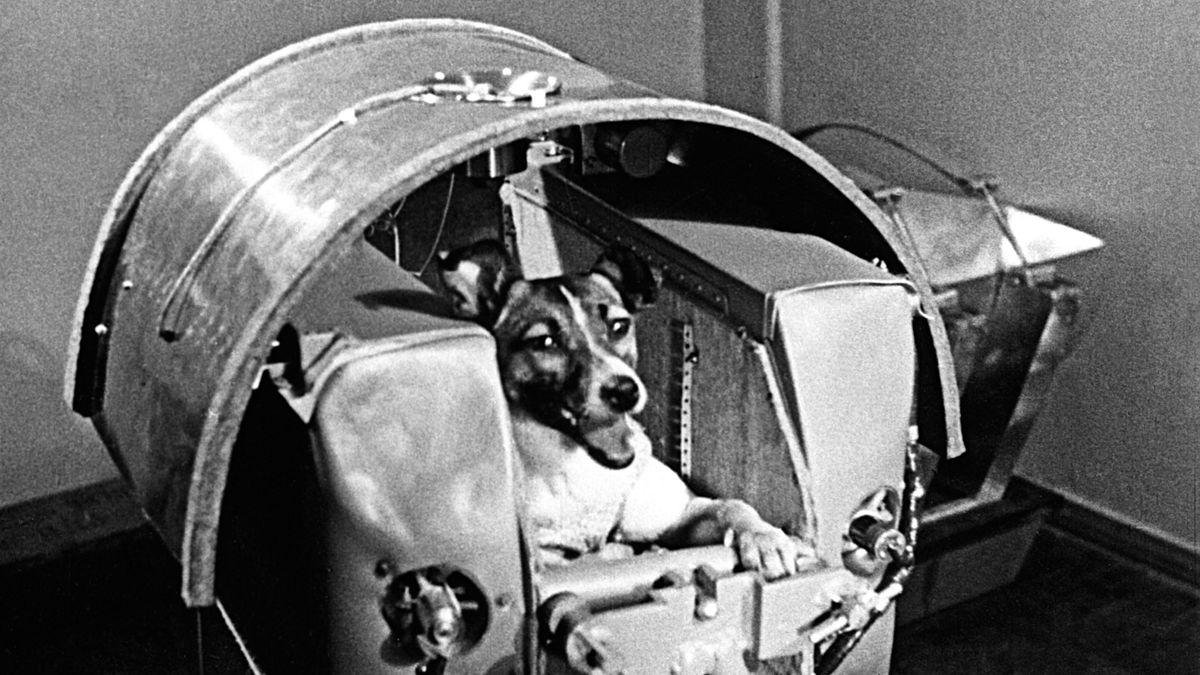
Two technicians lean into a tiny capsule, kiss a stray dog on the nose and wish her a good trip. It is October 31, 1957. Everyone standing around her knows she will never come home.
**Autumn 1957. Moscow.**
She has no owner, no collar and no birthday anyone ever wrote down. She is a small, mixed-breed female weighing about 6 kilograms, and she has survived on whatever the streets of Moscow were willing to give her.
Soviet scientists are collecting dogs like her on purpose. Their reasoning is simple: a stray that has already lived through hunger and freezing nights should cope better with the cold, cramped strangeness of a rocket than any pampered pet.
They want females, too. The cabin is so tight that a male dog would have no room to lift his leg.
The staff call her Kudryavka, which means Little Curly. The world will come to know her by a different name, Laika, which means barker.
**October 4, 1957.**
The Soviet Union launches Sputnik 1, a polished metal ball, about the size of a beach ball, that does little more than beep. The whole planet looks up.
Nikita Khrushchev wants more. The 40th anniversary of the Bolshevik Revolution falls on November 7, and he wants another triumph in the sky to mark the day.
That gives Sergei Korolev’s engineers less than four weeks to design and build a satellite that can carry a living passenger. There is no time for full blueprints, so much of it is built from sketches. The finished Sputnik 2 weighs 508 kilograms, about six times heavier than the first.
What it does not have is a way back. Nobody has yet built a capsule that can survive the fall through the atmosphere, so whoever goes up will stay up.
Laika and two other dogs, Albina and Mushka, are kept in smaller and smaller cages, for weeks at a time. They are spun in centrifuges and blasted with the roar of engines. Laika stays calm through all of it, and that calm is what wins her the seat.
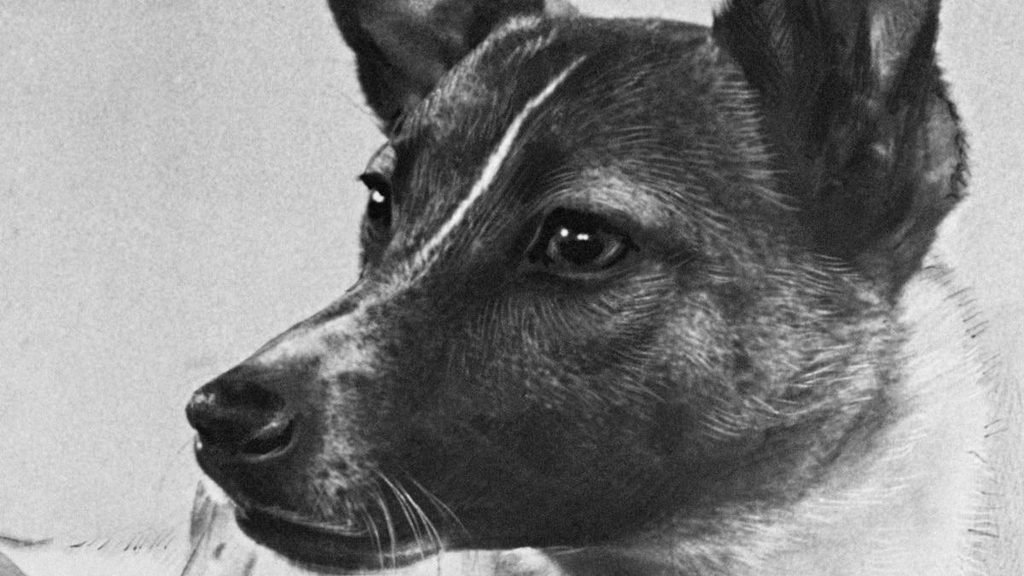
**A few days before launch.**
Dr. Vladimir Yazdovsky, the physician in charge of the dogs, does something that appears in no flight plan. He takes Laika home.
His son Viktor, who is 9 years old, gets to play with her. For a few hours, the stray from the streets is simply a family’s dog in a warm house, surrounded by people who are glad she is there.
Yazdovsky later wrote: “I wanted to do something nice for her.” He knew how little time she had left.
**October 31, 1957. Baikonur.**
Sensors for her heartbeat, breathing and blood pressure have been surgically attached. She is fitted into a harness and sealed into the pressurised cabin three full days before launch. The weather at the pad is cold, so a hose pipes in warm air to keep her comfortable while she waits.
Then the technicians kiss her nose, and the hatch closes.
**November 3, 1957.**
The rocket roars off the pad. Inside, Laika’s heart rate leaps from 103 beats a minute to 240, and her breathing races to three or four times its normal pace.
Then the shaking stops. She floats against her harness, the first living creature ever to circle the Earth, once roughly every 103 minutes.
On the ground, scientists watch her numbers. Her heartbeat takes about 3 hours to settle, around three times longer than it did in training, but she is alive and moving.
Around the world, newspapers cheer. Some nickname her Muttnik.
But the engineers had no time to perfect the cooling. Part of the insulation has come loose, and the thermal control system cannot keep up with the sun. The cabin climbs past 40°C, more than 104°F.
**Five to seven hours after launch.**
By the fourth orbit, the sensors show no more signs of life. Laika has died from overheating and stress.
The world is not told. For decades, the official story is that she lived for about a week in orbit and slipped away peacefully, the way the plan on paper said she would.
Sputnik 2 keeps flying without her. Within a week its batteries die. It circles the planet 2,570 times over 162 days before burning up in the atmosphere in April 1958.
**August 19, 1960.**
Two more stray dogs, Belka and Strelka, go up into orbit. The next day, they come home alive. The door Laika could only push open, they walk back through.
**April 12, 1961.**
Yuri Gagarin becomes the first human to orbit the Earth, and he lands safely. It is less than three and a half years after a little dog from the streets went first.
**1998. Moscow.**
Oleg Gazenko, the scientist who helped select and train her, is now an old man facing reporters. “The more time passes, the more I’m sorry about it,” he says. He tells them the mission should never have happened, and that they did not learn enough to justify her death.
**October 2002. Houston.**
At the World Space Congress, a Russian scientist named Dimitri Malashenkov finally presents what the instruments recorded. Laika did not live for a week. She lived for a few hours.
Forty-five years. That is how long a gentle story stood in front of a hard one.
Laika gave scientists the first proof that a living body could survive a launch and function in weightlessness, and that knowledge helped carry Gagarin home. She never chose any of it.
In 2008, Russia unveiled a monument near a Moscow research facility: a small dog standing proudly on top of a rocket. It took half a century, but they gave her the honour and the honesty she was owed.
Do you believe what we learned was worth her life, or should Laika never have flown at all?
Some stories deserve to be told truthfully, even the painful ones. This little dog’s story is one of them.