
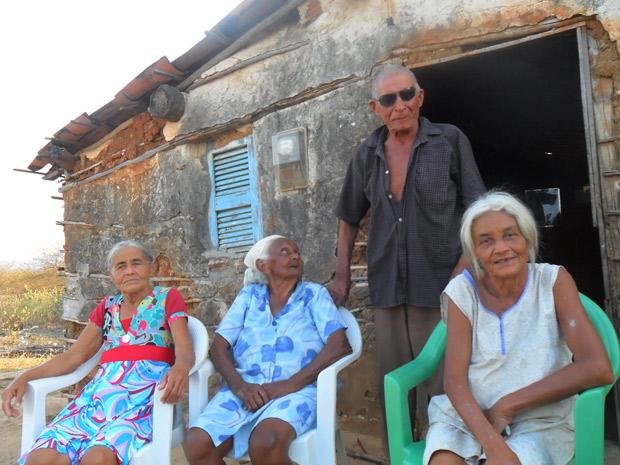
September 2011. Campo Grande, Rio Grande do Norte.
A local reporter heads into the countryside of northeastern Brazil. He is looking for a retired farm worker named Luiz Costa de Oliveira.
Luiz is 90 years old. He was born around 1921, and he has spent most of his life working the land with his hands.
He does not smoke. He has not touched alcohol in 40 years. For a man his age, his health is remarkably good.
But nobody has come to ask about his health. They have come to count his children.
The first family.
Luiz’s first wife gives him 17 children. Seventeen births. Seventeen mouths to feed on a farm worker’s earnings.
Then his first wife dies. Luiz is left a widower with a home full of children who need a mother.
Then a new mother steps in.
A woman named Maria Francisca da Silva comes into the family. She helps care for the 17 children from his first marriage, children who are not hers by birth.
She becomes Luiz’s second wife. Over the years, she gives birth to 17 more children of her own.
That makes 34 children in one family. Most people would stop there. Luiz does not.
Every pregnancy means weeks of recovery for Maria. During those weeks, her sister Ozelita Francisca da Silva comes to help.
She cooks. She cleans. She looks after the little ones while Maria rests.
Then the story takes a turn nobody expects.
Luiz and Ozelita begin a relationship of their own. Over the following years, Ozelita has 15 children with him.
Two sisters. One man. 32 children between them.
And the family tree is still not finished.
Luiz also fathers one child with Francisca Maria da Silva, the mother of Maria and Ozelita. His own mother-in-law. When the story breaks in 2011, she is reported to be 89 years old.
Add it up: 17 + 17 + 15 + 1. Exactly 50 children. Four women. Two of them sisters, and one of them their mother.
The interview.

Luiz sits down with the reporter and speaks openly. He hides nothing.
He tells him: “The best thing God made in the world was women.”
Then he admits something extraordinary. He cannot name all 50 of his children. He says there may be others out there he has never known about. Some reports mention 3 more possible children whose paternity he was never sure of.
Here’s what makes it worse: this is not a wealthy family. Reports describe a childhood of deep poverty. Some of Luiz’s children do not survive it.
Think about what that means. Mothers raising babies in hardship, year after year, burying some of them along the way.
So who keeps this enormous family going? The honest answer is the women.
Maria raises children who are not hers. Ozelita arrives to help and stays for a lifetime. Older children mind the younger ones. Relatives share the cooking, the washing and the worry.
The family lives side by side in a few simple homes near one another. It is crowded. It is complicated. But it holds together.
Asked about her husband, Maria tells the reporter: “He never mistreated us.”
She says he always looked after his children, and that they never went without. That is her memory of their life together, and she is the one who lived it.
The numbers keep growing.
By 2011, the family reports around 100 grandchildren. The great-grandchildren are harder to pin down. One report says 30. Others say 35, or even 60.
Here is the surprising part: nobody ever audited this family. There is no official register with every name in it. The numbers come from the family itself, told to reporters, and they never quite match.
The story goes national.
Brazilian newspapers pick it up. Then British and Asian papers follow. Readers around the world try, and fail, to sketch his family tree.
Five years later.
In 2016, the story resurfaces on social media as if it were brand new. A new generation discovers Luiz for the first time, and the same arguments start all over again.
June 11, 2017.
Luiz Costa de Oliveira dies at the age of 95.
He leaves behind 50 acknowledged children, around 100 grandchildren, and dozens of great-grandchildren. Four generations, spread across one small corner of Brazil.
People still argue about him. Some call him a family patriarch. Others call him something far less flattering. Both sides have a point.
But look past the man, and a different story appears. It is the story of 4 women who fed, clothed and raised 50 children with almost nothing, and kept a family standing for decades.
That is the part that never made the headlines. It is also the part that matters most.
Families are rarely neat. Some of them look strange from the outside. But every one of them survives because somebody quietly does the work.
What do you think of Luiz’s story? Family man, or something else? Tell us in the comments.
Someone who needs to know, the people who hold a family together are rarely the ones who get the headlines.