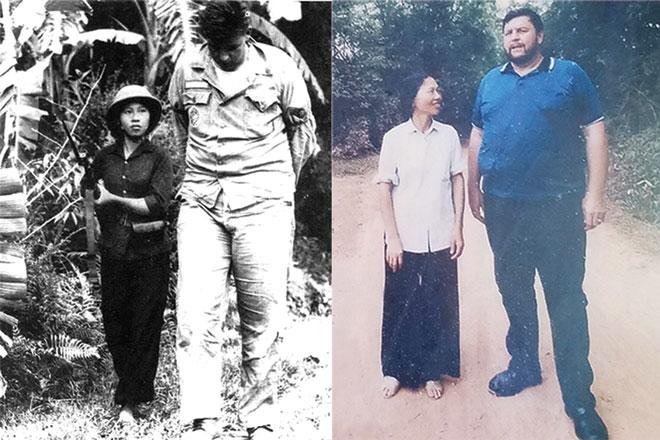
She was 17, stood about 1.5 metres tall and weighed 37 kilograms. The American airman walking beside her looked like a giant. In September 1965, one photograph of them went around the world. Neither of them expected to see the other again.
**September 20, 1965. The sky over Hà Tĩnh Province, North Vietnam.**
An American rescue helicopter is flying low over the hills, searching for a fighter pilot who has just been shot down. Its crew of 4 have one of the most dangerous jobs of the war: fly straight into the place where a plane has fallen and bring the pilot home.
In the back of the HH-43B Huskie sits Airman First Class William Andrew Robinson, a 22-year-old crew chief from North Carolina. He is not a pilot. He keeps the helicopter flying and works the hoist that lifts men out of the jungle. Decades later he described that work simply: “That’s what we did, and we did it proudly.”
He has done it before. In May that year he helped pull a downed pilot out under fire and earned the Silver Star.
This time, ground fire tears into the helicopter during the rescue attempt. The crew survive the crash and scatter into the forest.
**Hương Khê district. Soon after.**
Nguyễn Thị Kim Lai has finished 7th grade and joined the local militia, because the war is no longer far away. Bridges near her village are bombed. Roads are cut. She has only just learned to handle a rifle.
She and the other militia members comb the forest for the missing airmen. Near a rocky hiding place, she hears something move.
Robinson is crouched inside a small cave. He sees a figure coming toward him, and he has a weapon. He does not use it.
Years later he explained why, and the reason is almost funny. She looked so small.
Kim Lai fires 3 shots into the air. Robinson raises his hands, and the villagers who come running behind her tie him up.
**Later that day.**
She walks him to the district headquarters, rifle in her hands, bayonet fixed. In her memory he stood about 2.2 metres tall and weighed well over 100 kilograms. Crowds pour into the road to stare at the girl and the giant.
A newspaper reporter named Phan Thoan sees them and lifts his camera. One picture. A tiny militia girl in a pith helmet, and a huge man beside her with his head bowed.
That picture is about to travel much farther than either of them.
**1966 and 1967.**
The photograph, known as The Little Guerrilla, hangs in a national exhibition. A celebrated Vietnamese poet writes verses about it. In 1967 it becomes a postage stamp marking the 2,000th American aircraft North Vietnam claimed to have shot down.
The giant on that stamp is Robinson. And while his likeness travels through the mail, he is locked in a cell.
He passes through the infamous Hanoi Hilton, then camps the prisoners call the Briarpatch and the Zoo, where he endures interrogation, isolation and hunger. The men tap messages to each other through the walls in a code the guards cannot read, and those quiet taps keep many of them sane.
Christmas comes and goes. Then another. Then six more.
**1969.**
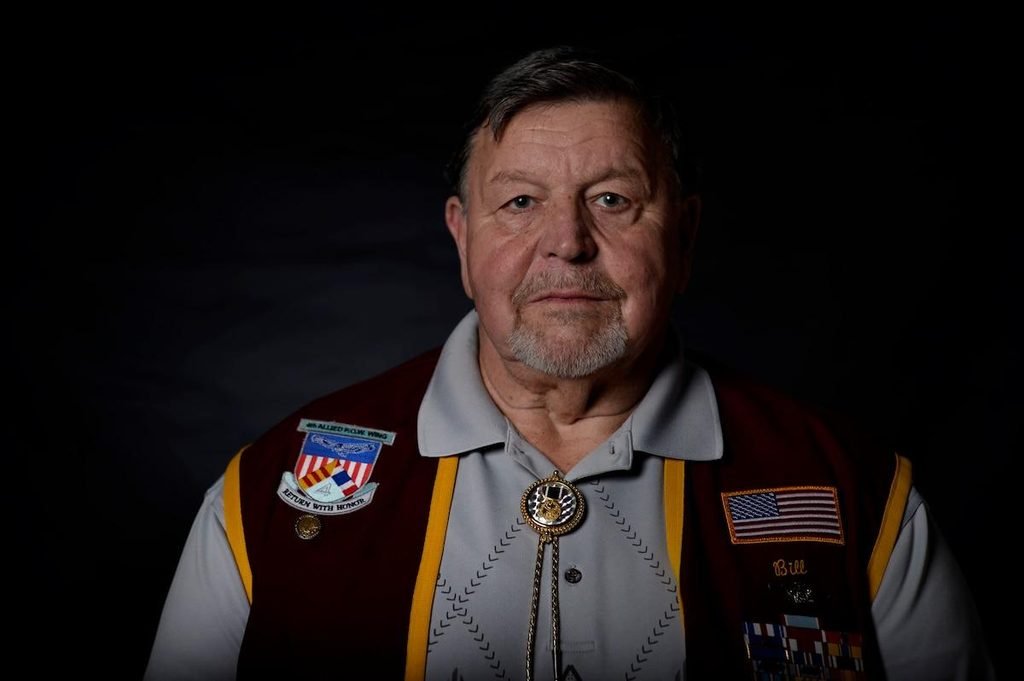
The senior officers locked up around him have watched this young enlisted man hold steady for 4 years. They decide he should be one of them. Graduates of the Air Force and Naval academies run a makeshift officer training course inside the camp, teaching customs, courtesies and Air Force history from memory, and Robinson receives a battlefield commission as a second lieutenant.
Read that again. He became an officer inside an enemy prison.
**February 12, 1973.**
Robinson finally boards a plane home. He has been a prisoner for 2,703 days, which is seven years, four months and 21 days. No enlisted American has ever been held longer.
That April, President Nixon makes his prison commission official. For the rescue mission that ended in his capture, he receives the Air Force Cross, and he is one of the first enlisted airmen ever awarded it.
Kim Lai’s life moves on too. She trains as a nurse and volunteers for the front in western Quảng Trị. Later, at a district hospital, she cares for a wounded soldier named Nguyễn Anh Đức. They fall in love, marry and raise 3 children.
Each of them assumes the other is gone for good, just a face in an old photograph.
**September 1995.**
Kim Lai is carrying her grandchild over to a neighbour’s house when someone calls her back. A foreigner is asking for her.
Standing at her home is a very tall American, 52 years old now. She knows him immediately.
A documentary team from Japan’s NHK, working with Vietnam’s central documentary film studio, has brought William Robinson back to the place where he was captured, 30 years after that photograph.
He looks down at her and teases that she still hasn’t grown much. She laughs and tells him he still looks young and strong.
They talk about the cave, the 3 shots fired at the sky, the long walk through the staring crowds. Then Robinson says something she never forgot. If either of them had pointed a gun at the other that day, he told her, they would never have had this reunion.
Both of them told the cameras the same thing: neither had wanted the war.
A photograph is supposed to freeze a moment. This one did the opposite. It kept two strangers tied together for three decades, until they could finish a conversation that began in a forest.
She could have fired lower. He could have reached for his weapon. Instead, a nurse and a former prisoner of war stood in a doorway in Hà Tĩnh and laughed about how small she still was.
In the years since, Robinson has told young airmen the same six words: “Don’t give up; don’t give in.”
Could you shake hands with someone who once stood on the other side of a war from you?
Some photographs only tell half a story.