
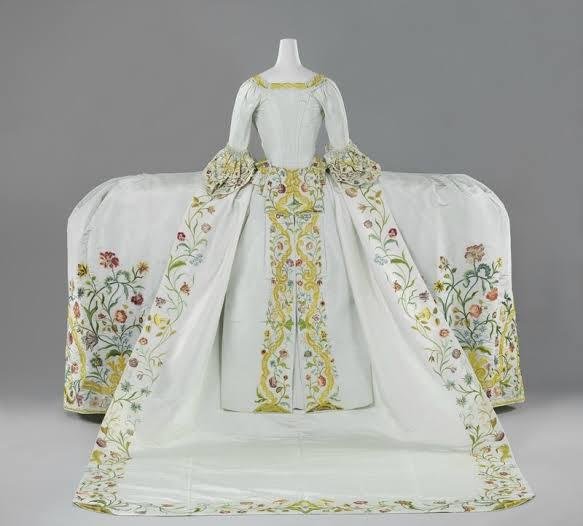
Two metres. That is how wide one young bride’s skirt measured on her wedding day in 1759. Her dress has survived for 267 years, and you can still see it in Amsterdam. Yet its most famous photograph hides a secret almost nobody notices.
**September 4, 1759.**
Helena Slicher is about 22 years old, and today she marries Aelbrecht van Slingelandt, a baron five years older than her, from a family that had helped govern the Dutch city of Dordrecht for generations.
Her gown is pale blue silk, not white.
That surprises people now, but white was not yet the bridal colour. According to the Rijksmuseum, 18th-century brides wore light blue, yellow or pink, or silk with fashionable woven or embroidered patterns. Only royal brides wore silvery white.
Across the blue, flowers bloom in silk thread of many colours. They are not printed but stitched by hand, petal by petal, by embroiderers and seamstresses whose names nobody wrote down.
Then there is the skirt.
It measures about two metres from side to side, which is wider than a king-size bed. Underneath it sit panniers, a framework of hoops worn at the hips that pushes the fabric out sideways while keeping the front and back fairly flat. From the side, she looks slender. From the front, she fills the room.
**Look closer, and the craftsmanship takes over.**
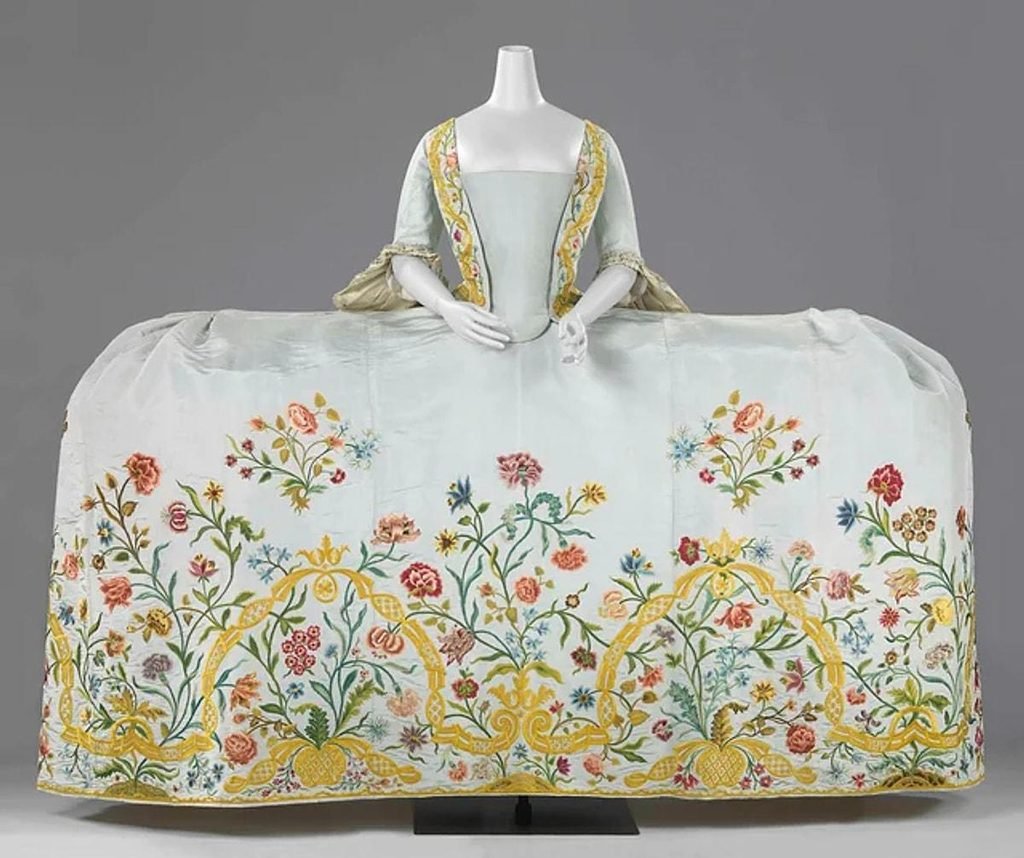
The skirt is pieced together from 8 widths of silk and stands 103 centimetres from waistband to hem, so the whole thing is roughly twice as wide as it is long. The hem is turned inward about 1.5 centimetres and held with a mix of large and small running stitches. Every stitch is done by hand. The sleeves are lined with linen. And this whole spectacular gown, made for one of the grandest days of her life, fastens at the waist with a simple linen tape.
All that silk and status, and it ties shut like a kitchen apron.
The design is unusual, too. The bodice, with its long trailing tail at the back, follows the English court dress known as the mantua. The loose train was a fashion of the Continent. The museum notes that combining the two in a single gown is rare. To a guest in 1759, the message would have been clear without a word spoken: this bride belongs among the most important families in the land.
**Seventeen years later.**
In 1776, Helena dies. She is only about 39. Her husband lives on for another 25 years, until 1801. Most of the everyday details of her life, her voice, her habits, the sound of her laugh, are not part of the public record.
But her wedding dress does not disappear.
**The next two centuries.**
Silk is fragile. It splits, fades and rots. Moths love it. Damp ruins it. Gowns like this were often cut up, remade or simply thrown away when fashions changed. Somehow, through more than 200 years of wars, moves and changing tastes, Helena’s dress survives in one piece.
**1978.**
A Dutch noblewoman, Jonkvrouw C.I. Six of ‘s-Graveland, gives it to the Rijksmuseum as part of a larger gift of historic clothing. The museum catalogues it in 3 parts, the bodice, the skirt and the train, under one number: BK-1978-247.
**February 20, 2016.**
The Rijksmuseum opens Catwalk, its first major exhibition of its fashion collection, across 6 galleries. Visitors walk past centuries of Dutch clothing, but Helena’s gown is the one billed as the widest dress in the Netherlands. The curator, Bianca du Mortier, puts it simply: “The garments presented in this exhibition reflect the stories of the people who wore them.”
The exhibition is designed by the celebrated Dutch photographer Erwin Olaf. For it, he creates a striking portrait of a young model, Ymre Stiekema, standing in Helena’s wedding gown. It is the image many people now picture when they think of this dress.
She never wore it.
Read that again. The real dress is far too fragile to be put on a living person, so Olaf photographed the gown and the model separately and combined the two pictures digitally. The bride in that famous photo is not really wearing the dress at all.
Over the years, the internet has added its own legends. Many captions claim Helena had to turn sideways to squeeze through every doorway. There is no record of that. A skirt this wide would certainly have made narrow doors and crowded rooms awkward, but the true story needs no exaggeration.
**Today.**
We have no famous letters from Helena Slicher, and no great deeds attached to her name. What we have is a moment, held in silk thread: one September day when a young woman stood at the start of her married life, wearing something extraordinary.
Someone, at some point, decided that moment was worth keeping. Then someone else agreed, and so did the next person, for more than two centuries.
Is there a piece of clothing in your family that has been kept for generations? Who wore it, and why do you think someone saved it?
Most of history is written about kings and battles. But some of it survives because an ordinary person folded something carefully and refused to throw it away.