
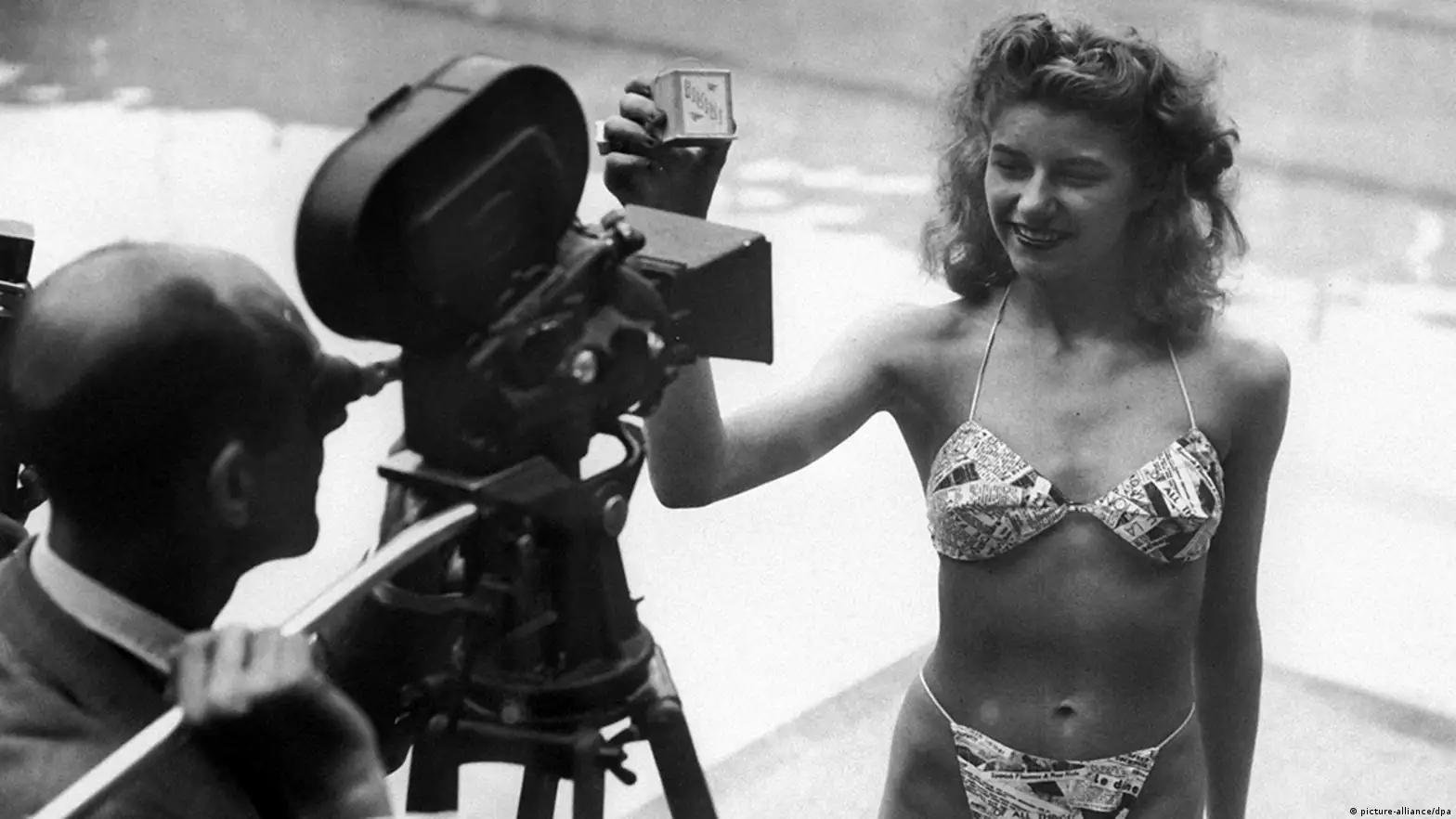
Everyone knows the bikini. Almost nobody knows the name of the young dancer who wore it first, in front of the cameras in Paris in 1946, after the professional models had turned it down. She was a showgirl, and she held one small box.
**Summer 1946. Paris.**
The war in Europe has been over for barely a year. Fabric is still rationed, money is still tight, and for the first time in a long while, people are thinking about the beach again.
Louis Réard is an automobile engineer who has ended up running his mother’s lingerie business in Paris. He has noticed something on the beaches at Saint-Tropez. Women are rolling up the edges of their swimsuits to catch more sun.
He thinks he can do better than rolling.
He is not the only one. Weeks earlier, the fashion designer Jacques Heim has launched a two-piece called the Atome and advertised it as the world’s smallest bathing suit.
Réard takes that as a challenge.
His design is four small triangles of cloth held together with string. In total, it uses about 30 square inches of fabric. That is roughly a third of one sheet of typing paper, stretched across a whole swimsuit.
He promotes it with a cheeky slogan: smaller than the world’s smallest bathing suit.
**July 1, 1946.**
Across the world, the United States detonates an atomic bomb over Bikini Atoll in the Pacific. The test fills newspapers everywhere.
Réard gives his swimsuit the name of that faraway atoll. He never publicly explained the choice, but the timing is hard to miss.
He now has a design, a name and a date. What he does not have is a model.
The professional fashion models he approaches will not wear it. The suit shows the navel, the hips and far more skin than any respectable swimsuit of the day, and the models consider it far too scandalous to wear.
The launch is only days away, and the one thing he cannot make himself is a woman willing to stand in front of the press in it.
So he looks somewhere the fashion world never looks.
Micheline Bernardini was born on December 1, 1927, in Colmar, in the Alsace region of France. She is 18 years old and dances at the Casino de Paris, one of the city’s famous music halls.
She is used to stage lights and audiences. When Réard asks, she says yes.
**July 5, 1946. Piscine Molitor, Paris.**
It is a popular public swimming pool in the 16th arrondissement, and on this summer day it is full of photographers.
Micheline steps out in the tiny suit. Réard has had the fabric printed with newspaper type, a little joke about the headlines he knows are coming.
In her hand she holds a small box, barely bigger than a matchbox. The point is simple and theatrical. The entire swimsuit folds up and fits inside it.
The cameras click. The pictures travel.
The International Herald Tribune alone runs nine stories on the event. Micheline reportedly receives about 50,000 fan letters.
Read that again. Fifty thousand letters, posted by hand, to a young dancer most of the world had never heard of a week before.
Fourteen days after the show, Réard applies for a patent on his design. It is granted as number 19431.
**The years that follow.**
Not everyone is charmed. Spain and Italy pass measures against bikinis on public beaches. Portugal and Australia restrict or ban them too.
In the United States, the bikini is largely resisted until the early 1960s.
Réard does not back down. In his advertisements he insists that a two-piece is not a genuine bikini unless it could be pulled through a wedding ring.
**1948.**
Micheline does not chase a modelling career on the back of her famous afternoon. She travels to the other side of the world instead.
From 1948 to 1958, she appears in revues at the Tivoli Theatre in Melbourne. Australian audiences come to see the French dancer who once stood beside a Paris pool holding a box the size of a matchbox.
Slowly, the world catches up with her. In 1960 a pop song about an itsy bitsy yellow polka-dot bikini climbs the charts. In 1962, Ursula Andress walks out of the sea in a white bikini in the first James Bond film, Dr. No.
**1986.**
Forty years after Piscine Molitor, Micheline Bernardini poses in a bikini once more, this time for the photographer Peter Turnley.
She is 58 years old.
The same woman, four decades apart, standing in the same small piece of history.
History usually remembers the person who designed something. Réard’s name is on the patent, and that is fair.
But a design is only a drawing until somebody is brave enough to stand up in public and wear it. On July 5, 1946, that person was an 18-year-old dancer who said yes when the professionals said no.
Have you ever been the first to try something everyone around you was too nervous to do?
Some stories deserve to be remembered, and hers is one of them.